In the days before Sega unleashed it’s ultimate mascot figure, Sonic The Hedgehog, upon the masses, they had to rely on other games to sell the then new Sega Mega Drive/Genesis.

Initially, Sega were reliant on conversions of their much admired and praised arcade hits of the time: Altered Beast (the first pack in title for the system), Golden Axe, Space Harrier II. Third parties also contributed with titles such as Ghouls ‘n Ghosts (albeit a conversion developed and distributed by Sega thanks to Nintendos highly restrictive practices towards companies like Capcom, etc releasing games on other platforms), Hard Drivin’, Klax, etc.
Original titles were also out there to try and tempt gamers to Segas 16bit powerhouse: Phantasy Star II, Alex Kidd in The Enchanted Castle, Super Hydlide, Cyberball, etc.
And licences were seen as a way to move games and systems. Sega themselves had James “Buster” Douglas, Michael Jackson, Pat Riley, and the Ghostbusters all appearing as licensed characters in games (usually with their name in the title).
But sales were not what Sega Japan had expected. Sure, shifting around 400,000 systems in the first year against the juggernaut that was the NES was impressive, but allegedly, Sega Japan had demanded 1,000,000 units in that timeframe. Enter Electronic Arts.

EA had a stellar reputation at the time. They were responsible for some excellent home computer titles, and renowned for treating developers as artists under the guidance of company founder Trip Hawkins. Despite some legal issues over EA reverse engineering the system to be able to manufacture it’s own carts at a significantly lower cost than Sega were charging, they became an official licensee and began to release titles for the Genesis/Mega Drive. And it was their first release that proved somewhat pivotal in the fortunes of the system in the marketplace.

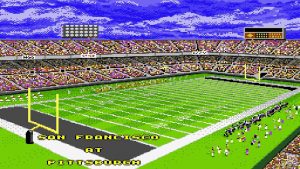
Released in November 1990, a little over a year after the Genesis debuted in the US, John Madden Football took the market by storm. By presenting a much more realistic (for the time) take on the sport when compared to other home console gridiron game such as 10 Yard Fight, Madden gave gamers an experience that was truly unavailable on the NES. a pseudo 3D field of play, and expansive playbook, and simple, easy to grasp controls all contributed to a game that set the standard for sports titles in the 16bit era. Yes, it didn’t have the elusive NFL license just yet (that would come with time), but it lit a fire in gamers and helped propel sales of the Genesis that holiday season into the stratosphere. Expected by EA to sell somewhere in the region of 40,000 copies, it ultimately sold around 10x this amount. And even more impressively, it reviewed and sold well in markets such as the UK where the sport had a small, but vociferous fanbase.
EA would follow up the success of Madden with it’s EA/NHL Hockey series, various NBA basketball titles, and a slew of well received no sports titles, cementing themselves as perhaps the most important third party publisher/developer in the Western market.