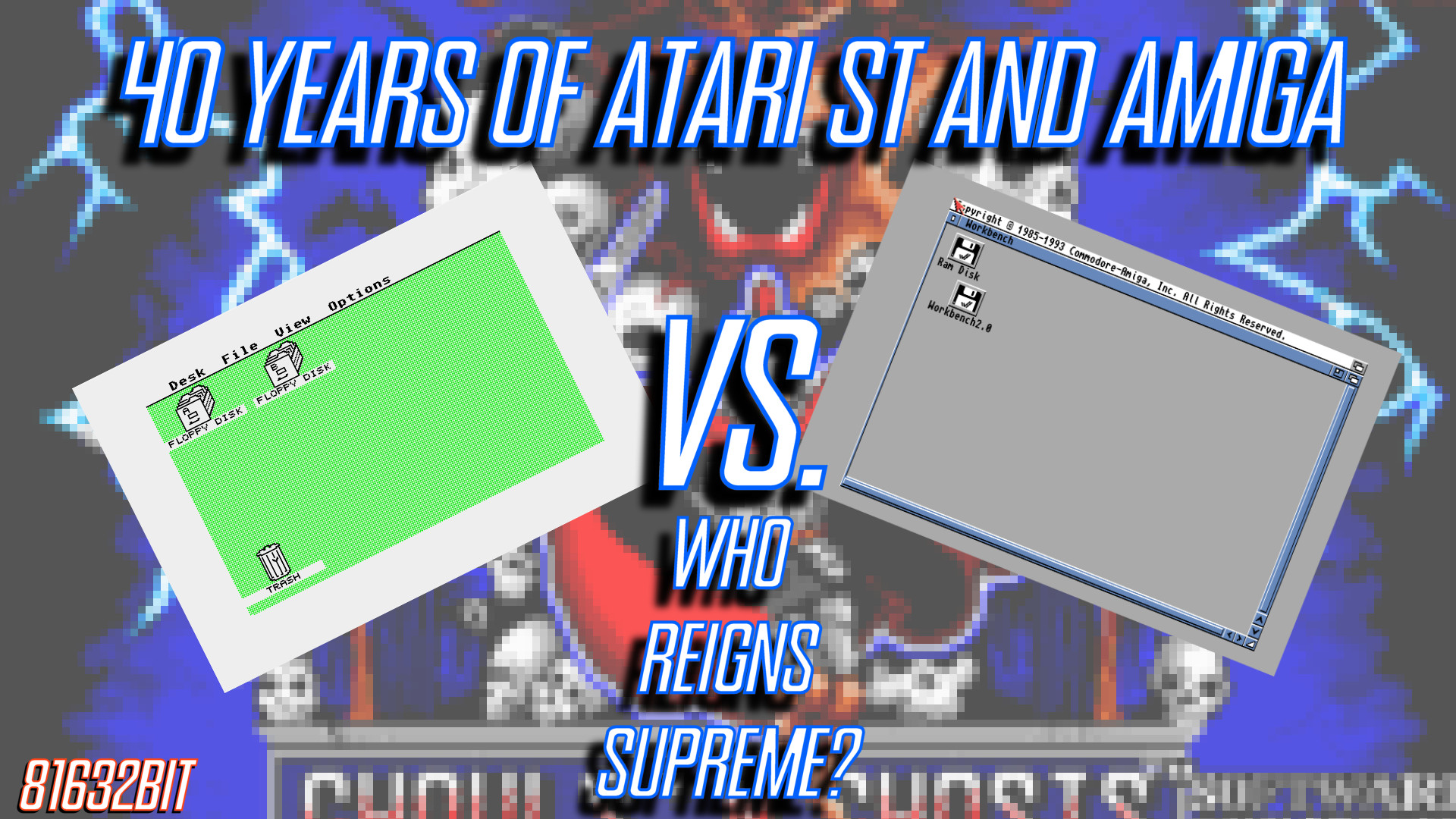
Yep, it’s been just a smidge over 40 years since the 16bit home computer war between Atari with it’s ST, and Commodore with it’s Amiga began. 40 damn years. 1985 wasn’t really 40 years ago, was it? Apparently it was…
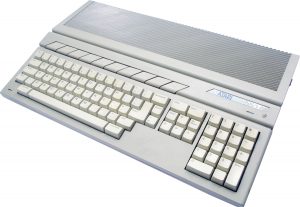
So, the ST and Amiga both officially launched in July of 1985. The ST was first out of the blocks and into retailers stores, and did so at a significantly lower price point, being just $799 for the computer itself and a monochrome monitor, or $999 with a colour one instead. This compared very favourably to the Amiga 1000s $1285 price for a complete system with colour monitor.
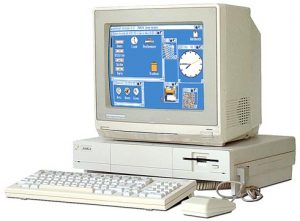
The ST also came in a more familiar form factor for the home suer at the time being a desktop “wedge” system with a built in keyboard and 3.5″ FDD, as opposed to the Amiga 1000s more workstation like appearance complete with separate keyboard.
By the end of the year a minor tweak had been made to the ST making it even more of a desirable option as a TV modulator was included, negating the need to buy an expensive monitor with your computer.
Now, in terms of hardware, both systems were based around the then state of the art Motorola 68000 cpu. This hybrid 16/32bit CPU (which is where the ST got it’s name from) became ubiquitous in the late 80s and early 90s, powering multiple systems such as the Mega Drive, Neo Geo, Sharp 68k, and numerous arcade boards from the likes of Sega, Namco, Taito, etc. In terms of raw clockspeed, the ST was clocked higher at 8mhz, as opposed to the Amigas 7.14mhz, but the Amiga had something up it’s sleeve that the ST did not: The OCS.
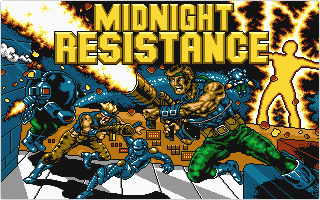
The OCS, or Original Chip Set, was the “secret sauce” that with the eventual release of the A500 “wedge” system lead to the Amiga becoming the dominant (in the West anyway) 16 bit home computer. The extra capabilities provided by the custom chips in the OCS gave the Amiga a significant advantage in terms of graphics and sound. And we all know gamers are easily distracted by shiny shiny things.
Now, for the first 2 or so years from 85 through to 87, the ST was the more popular machine despite being clearly less capable than the Amiga, and this was almost exclusively down to pricing. The ST was consistently and significantly cheaper to buy that the Amiga was. So game developers made sure to elad with an ST version then convert to the Amiga, often not utilising the extra graphics hardware contained therein. This lead to many underwhelming games being released for the Amiga which further bolstered Ataris market lead.
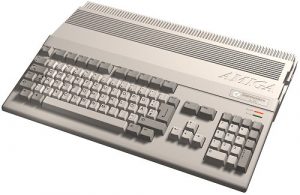
However, the previously mentioned A500 launch in 1987. Having a near identical form factor to the ST, this cost reduced Amiga sold at a lower price, which helped boost sales quite significantly. Yes, it was still more expensive that the ST, to the tune of roughly £100/$100, but the improved specs meant that many gamers either skipped the ST entirely and went straight to the Amiga, or traded their trusty ST for one instead. And developers noticed this, and soon began to lead with the Amiga version before “downgrading” it to an ST version.
Ultimately, the Amiga became much more popular than the ST did. Even with Ataris attempts to level the playing field with the 1989 release of the enhanced STE model, which was much closer to the Amiga in terms of specs, the war was in effect over. Yes, the ST had a loyal fanbase (especially amongst musicians), but the Amiga became THE 16 bit home computer format of choice.
Of course, neither side truly won, as by the mid 1990s, both companies were under heavy financial strain and even the much anticipated Atari Falcon 030 and Amiga 1200 couldn’t save them from the dual onslaught of the PlayStation and the 3Dfx powered PC gaming revolution.
Commodore won the battle, but neither side won the war. It was a case of M.A.D.